
Author name: Hrd_admin

Leadership

Workplace Psychology: Making Workplaces Better Using Psychology

Workplace Psychology: Making Workplaces Better Using Psychology By Nash Nithi Workplace psychology, a branch of industrial-organisational psychology, examines how people behave at work with the aim of improving productivity, job satisfaction and overall well-being. By applying psychological principles, organisations can design healthier, more efficient environments that benefit both staff and employers. This overview highlights core areas of workplace psychology, such as employee motivation, stress management, teamwork, leadership and organisational culture, while outlining strategies to improve workplace dynamics. Understanding Employee Motivation Motivation plays a central role in shaping employee performance and satisfaction. By understanding what drives individuals, managers can create conditions that nurture engagement. Key Motivation Theories Maslow’s Hierarchy of Needs: Suggests that individuals have different levels of needs—ranging from basic survival to self-fulfilment. Addressing these needs, from safety to recognition, can inspire greater motivation. Herzberg’s Two-Factor Theory: Distinguishes between hygiene factors (like salary and work conditions) that prevent dissatisfaction, and motivators (like recognition and responsibility) that spark true engagement. Self-Determination Theory (SDT): Highlights autonomy, competence and relatedness as key drivers of motivation. Employees thrive when they feel in control, skilled in their work and connected to others. Practical Strategies Goal Setting: Clear, specific, and measurable goals (using the SMART framework) help employees stay focused and motivated. Incentives: Rewards, recognition and opportunities for development—both monetary and non-monetary—can significantly boost morale. Managing Stress in the Workplace Stress can undermine health, productivity and satisfaction. Proactive stress management is therefore vital for a healthy work culture. Identifying Stressors Heavy workloads, lack of autonomy, unclear expectations and poor work-life balance are common sources of stress. Surveys and open communication can help uncover these issues. Reducing Stress Workload Management: Ensure tasks are realistic and encourage breaks to avoid burnout. Support Systems: Provide access to counselling, EAPs and other resources. Healthy Environments: Comfortable workspaces with good lighting, ergonomic setups and wellness initiatives can ease stress. Strengthening Teamwork Strong teamwork is critical for organisational success. By fostering collaboration and addressing group dynamics, organisations can boost both performance and employee satisfaction. Building Effective Teams Diversity: A mix of skills, backgrounds and perspectives fosters creativity and problem-solving. Defined Roles: Clarity in responsibilities prevents misunderstandings and conflict. Open Communication: Honest dialogue builds trust and cohesion, supported by regular team discussions and feedback sessions. Resolving Conflict Conflicts are natural but need to be managed constructively. Mediation: Neutral facilitators can help teams find solutions. Training: Teaching conflict resolution skills empowers employees to address issues effectively. Leadership and Management Good leadership steers teams towards achieving goals and shapes workplace culture. Recognising different leadership styles helps leaders become more effective. Leadership Styles Transformational Leadership: Inspires and motivates through vision and innovation, often leading to higher engagement. Transactional Leadership: Focuses on rules, structure and rewards. Effective for task completion but less so for long-term inspiration. Servant Leadership: Puts team needs first, encouraging development and trust. Developing Leaders Training: Ongoing learning in communication, decision-making and emotional intelligence strengthens leadership skills. Mentorship: Pairing rising leaders with mentors provides guidance and growth opportunities. Shaping Organisational Culture Culture reflects the shared values, beliefs and behaviours within an organisation. A positive culture enhances retention, satisfaction and performance. Core Elements Values & Mission: Clear goals and values give employees purpose. Recognition: Celebrating contributions reinforces positive behaviours. Work-Life Balance: Policies like flexible hours or remote work support overall well-being. Building and Sustaining Culture Leadership Commitment: Leaders must demonstrate the culture they want to instil. Employee Involvement: Encouraging staff participation in decisions builds ownership and alignment. Workplace psychology provides valuable insights into creating better environments for employees. By addressing motivation, managing stress, enhancing teamwork, supporting leadership and cultivating a positive culture, organisations can unlock both individual potential and collective success. As workplaces continue to evolve, applying psychological principles will remain key to building organisations where employees thrive.


Leadership, TECH

Morgan Stanley Develops own AI System

Morgan Stanley Develops own AI System By Joash Pandita Morgan Stanley, a leading American multinational investment bank and financial services provider, has rolled out its second generative AI tool called AI @ Morgan Stanley Debrief. Designed to support financial advisors, the tool summarises video meetings and prepares follow-up emails, reinforcing the firm’s ongoing partnership with OpenAI. This new development follows the successful launch of the AI Knowledge Assistant in September 2023, which enables advisors to quickly access insights from Morgan Stanley’s vast research library. Alexandra Mousavizadeh, co-founder of Evident, highlighted that Morgan Stanley’s decision to build its own AI solutions, rather than rely on ready-made products, reflects a growing movement across the financial services sector. Tailored AI tools integrate more smoothly with existing processes, ultimately boosting efficiency and effectiveness. Mousavizadeh also noted that designing AI for specific requirements is especially valuable in industries like insurance and retail. “you get to design it, make it to fit into your workflows and just make it more seamless,” Alexandra Mousavizadeh, co-founder of Evident Other major banks, including BNP Paribas and TD Bank, are also collaborating with specialized AI developers such as Mistral AI and Cohere. Yet, Morgan Stanley distinguishes itself through its deep customization and integration, powered by OpenAI’s GPT model. David Wu, Morgan Stanley’s Head of AI Product & Architecture Strategy, explained that building proprietary AI tools ensures seamless interaction with the firm’s existing platforms like Microsoft Outlook, Zoom, and Salesforce. Unlike generic alternatives, these customized solutions are specifically designed to meet the unique needs of their advisors. Although still in its early rollout phase, this strategy signals a bold move towards in-house AI development to drive productivity and enhance client service. The firm’s partnership with OpenAI has already shown strong results, with its knowledge assistant tool being actively used by 98% of teams. This success highlights the long-term value of customized AI applications and underscores that artificial intelligence is set to remain a central force in the financial industry.

Leadership, TECH

AI and Ethics

AI and Ethics By Nash Nithi In today’s era of rapid technological progress, artificial intelligence (AI) has become a powerful force reshaping industries such as healthcare, finance, and transportation. While AI offers tremendous opportunities for innovation and efficiency, it also raises critical ethical questions that must be addressed to ensure its responsible use. This article highlights some of the pressing concerns—including algorithmic bias, data privacy, and responsible AI practices—and connects them to broader ethical frameworks championed by educational institutions like the University of Information Technology (UNIMY). Algorithmic Bias: An Ongoing Concern A key ethical issue in AI is algorithmic bias, which arises when flawed data or assumptions cause AI systems to produce unfair outcomes. For instance, facial recognition software has been criticised for being less accurate in identifying people from certain racial backgrounds, reinforcing inequality and discrimination in areas such as hiring, policing, and loan approvals. Institutions like UNIMY play an important role in tackling this challenge by embedding ethics into AI education. By training students to understand how bias originates and how it impacts real-world systems, universities prepare them to design fairer and more transparent AI models. Additionally, academic research contributes to creating tools and methods to detect and reduce bias in algorithms. Data Privacy: Protecting Personal Data AI relies heavily on large amounts of data, which brings significant concerns about consent, security, and misuse of personal information. With data breaches and cases of unauthorised use becoming more common, public trust in how AI handles personal data is increasingly fragile. To address this, newer methods are being developed to prioritise privacy in AI systems. Examples include federated learning, where models are trained on decentralised data without centralised storage, and differential privacy, which protects individual identities by adding randomness to datasets. Universities like UNIMY can lead in this area by conducting research and equipping students with skills in privacy-focused technologies, ensuring that future AI experts prioritise the safeguarding of personal information. Responsible AI Development: Principles and Implementation Responsible AI refers to developing and applying AI systems according to principles such as fairness, transparency, accountability, and safety. However, putting these values into practice is not always straightforward—it requires making AI understandable to users, ensuring developers are held accountable, and guaranteeing that AI benefits society. Academic institutions play a central role in advancing responsible AI. UNIMY, for example, can integrate case studies and hands-on projects into its curriculum, encouraging students to consider ethics in practical scenarios. Collaborations across disciplines—bringing together engineers, ethicists, and industry leaders—further enrich education and ensure students develop a holistic view of AI’s ethical implications. The Future of AI: Policy and Collaboration As AI continues to evolve, policymaking becomes increasingly crucial in shaping its ethical landscape. Governments and international organisations have already introduced regulations, such as the EU’s GDPR, which sets standards for data privacy, while other frameworks address wider ethical concerns. UNIMY and similar institutions can contribute meaningfully by sharing expertise, conducting research, and collaborating with policymakers and industry. These partnerships ensure regulations support both technological progress and ethical responsibility. The ethical challenges posed by AI are complex but vital for its sustainable integration into society. Educational institutions, especially universities like UNIMY, play a pivotal role in developing ethical AI practices through teaching, research, and engagement with policy debates. By instilling values of accountability, fairness, and privacy, universities help shape professionals who are not only skilled but also conscious of AI’s broader societal impact. Looking ahead, the dialogue between technology and ethics will only intensify as AI becomes more advanced. It is essential for academics, industry practitioners, policymakers, and the public to work together to address emerging concerns and ensure AI development aligns with human rights and dignity. In conclusion, building responsible AI is an ongoing process. Institutions like UNIMY are at the heart of this journey, guiding innovation while acting as ethical compasses. Through education, research, and policy influence, they help ensure AI technologies bring lasting, positive change to society. Explore the programmes offered by UNIMY today.

Compliance

Project Management Tips

Project Management Tips A guide to effective teamwork By Nishant Thomas Philip We are introduced to the value of teamwork from an early age, even as far back as kindergarten. Beneath its simple surface, teamwork involves a complex mix of psychology, adaptation, and problem-solving. Looking at different group activities, it’s often puzzling why some succeed effortlessly while others struggle and fail. What makes teamwork effective? Scholars have long debated whether teamwork is about collective intelligence and effort or simply aligning individuals toward a common goal. In reality, it is a blend of both. Productive teamwork is not an absolute formula, but certain elements are essential—most importantly, leadership. Without proper guidance, coordination, and balance of responsibilities, teams risk falling into disarray. Key Roles in a Team A team functions much like a machine, where every part plays a role in keeping it running. If one component fails, the entire system suffers. This doesn’t mean members should limit themselves to one rigid function—adaptability and the ability to contribute ideas are just as crucial. Let’s break down some of the essential archetypes that often define team structures. Leader The leader serves as the central figure who delegates responsibilities and makes final decisions after group discussions. However, leadership is not about authoritarian control. A good leader balances authority with empathy, earning respect rather than demanding it. They should lead with decisiveness but also remain approachable, fostering collaboration. Effective leaders juggle many roles, but with team support, the process becomes far smoother. Vice Leader Acting as the second-in-command, the Vice Leader steps in when the main leader is unavailable. This role is more than just a substitute; they serve as a bridge between the leader and the rest of the group. Ideally, the Vice Leader should be approachable, level-headed, and capable of addressing concerns team members might hesitate to bring directly to the leader. Secretary Though the title may sound more corporate, having a secretary-like role within a team is highly valuable. This person works closely with the leader to manage tasks, ensure smooth coordination, and keep records of key decisions. The role suits someone highly organised and detail-oriented, as they carry the responsibility of documenting progress and keeping everyone informed. Warning Signs in a Team Not every project runs smoothly—sometimes, teams create their own roadblocks. While challenges are natural, certain behaviours can harm efficiency if left unchecked. Two common extremes often cause problems: Narcissistic Leaders It’s natural to enjoy recognition, but some individuals take this too far. Leaders with strong narcissistic tendencies may micromanage, hoard credit, and undermine the team’s morale. When this happens, the group must either encourage a change in behaviour or, in severe cases, remove the disruptive individual. Backbenchers On the opposite end of the spectrum are backbenchers—those who contribute little, avoid responsibility, and rely on others to carry the workload. Often called freeloaders, they drain motivation and slow down progress. Addressing this issue early prevents them from disrupting the team’s flow. These insights are not universal solutions but guidelines to help teams handle common challenges. By recognising important roles and addressing toxic behaviours, teams can improve their chances of achieving success together.

Partnership

A Milestone in Legal Education

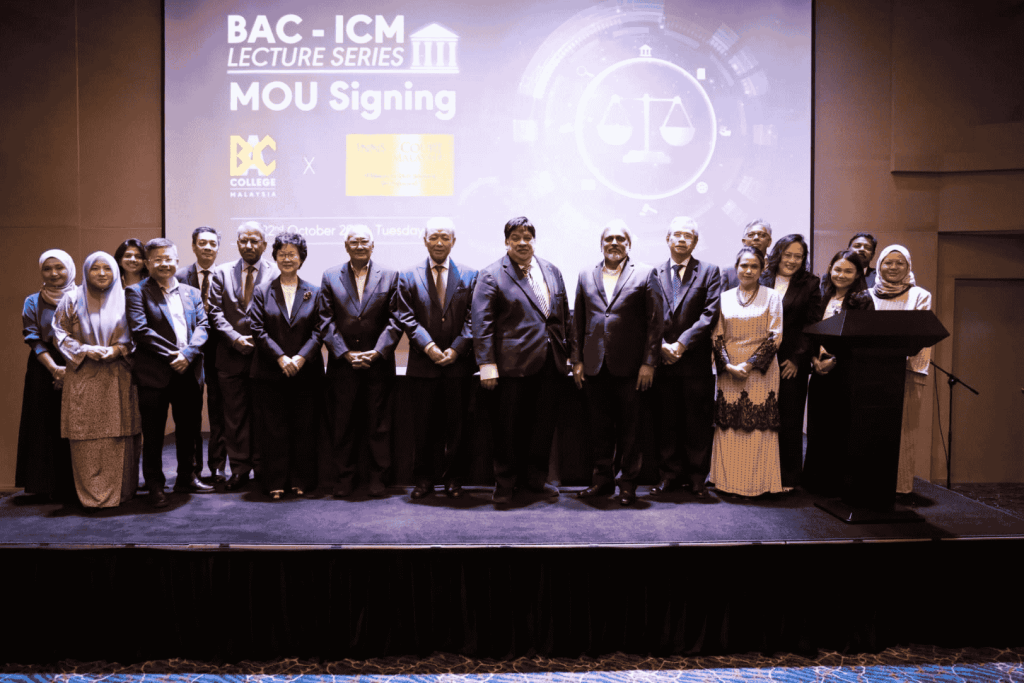
A Milestone in Legal Education BAC and the Inns of Court Malaysia Forge Historic Partnership By Joash Pandita A Grand Opening with Distinguished Guests On 22nd October 2024, Brickfields Asia College (BAC) together with the Inns of Court Malaysia (ICM) celebrated a historic milestone through the signing of a Memorandum of Understanding (MoU) for the BAC-ICM Lecture Series. The ceremony, held at the Horizon Banquet Hall in Menara BAC, marked a significant step forward for the legal profession. For the first time in its 33-year journey, BAC welcomed two retired Chief Justices, a retired Federal Court Judge, five prominent judges, and a King’s Counsel, making the occasion truly remarkable in its pursuit of legal excellence. The evening began with a welcome speech from Mr. Raja Singham, Chief Future Officer of the BAC Education Group. He reaffirmed BAC’s mission to push the boundaries of legal education and highlighted how this lecture series will serve as a platform to enhance the growth and professionalism of aspiring lawyers. The Role of Judges in Promoting Access to Justice The inaugural lecture of the BAC-ICM Lecture Series featured a powerful keynote by Yang Berbahagia Dato’ Mary Lim Thiam Suan, Director of the Asian International Arbitration Centre (AIAC) and Deputy President of ICM. Her address, titled “The Role of Judges in Promoting Access to Justice”, shed light on the judiciary’s vital role in safeguarding fairness and ensuring equal access to justice, leaving participants with a profound understanding of judicial responsibilities. Dato’ Mary Lim reflected on the historical foundations of access to justice, tracing back to the Magna Carta and its lasting impact, particularly within the UK’s legal framework. She explained access to justice as the fundamental right of individuals to seek remedies when wronged, stressing that the groups who gain the most are often the underprivileged, including the poor, children, and those often overlooked by society. In her closing message, she encouraged law students to remain focused on their studies, underlining the importance of critical thinking and legal understanding as the cornerstones of becoming competent and ethical legal practitioners. The Signing of a Historic MoU After the thought-provoking lecture, the MoU was officially signed, solidifying a partnership dedicated to advancing legal education and professional growth. This collaboration will open doors for BAC students to receive unmatched mentorship, internships, and international exposure—equipping them with the tools needed to thrive in the legal arena. The signing was witnessed by all attending judges, adding even greater significance to the occasion. It marked not only a key milestone in education but also reaffirmed BAC’s reputation as Malaysia’s leading law school. This partnership sets the stage for BAC students to excel, both nationally and internationally. Networking and Hi-Tea The evening ended with an engaging networking session where students, faculty members, and professionals had the rare opportunity to converse with the distinguished judges. Over a relaxed hi-tea, participants shared reflections on the day’s theme of access to justice and discussed how initiatives like this lecture series help shape the future of Malaysia’s legal landscape. The inaugural BAC-ICM Lecture Series concluded on a high note, inspiring all in attendance and paving the way for future collaborations between BAC and ICM. With a shared vision to elevate legal education, this partnership signals the beginning of a transformative journey for both institutions. A Special Acknowledgement to Our VVIP Guest Judges We extend our deepest appreciation to the distinguished judges whose presence elevated the significance of this historic event. Their invaluable insights and support reflect the unwavering dedication of Malaysia’s legal community to uphold justice, fairness, and integrity. Their participation serves as an inspiration for future generations of legal professionals and underscores the importance of collaboration in advancing legal excellence. Yang Amat Berbahagia Tun Arifin bin Zakaria – President of ICM, Retired Chief Justice of Malaysia Yang Amat Berbahagia Tun Dato’ Seri Zaki Tun Azmi – Advisor of ICM, Retired Chief Justice of Malaysia Yang Berbahagia Dato’ Mary Lim Thiam Suan – Director of AIAC, Deputy President of ICM, and Retired Federal Court Judge of Malaysia Yang Arif Datuk Vazeer Alam Mydin Meera – Federal Court Judge, Vice President of ICM Yang Arif Dato’ Lee Swee Seng – Judge of the Court of Appeal, ICM Exco Member Yang Arif Datuk Nantha Balan – Judge of the Court of Appeal, ICM Exco Member Yang Arif Tuan Nadzarin Wok Nordin – Judge of the Kuala Lumpur High Court, ICM Exco Member Yang Arif Dr Shahnaz Sulaiman – Judge of the Kuala Lumpur High Court, ICM Exco Member Steven Perian – First Malaysian King’s Counsel

Partnership

A Landmark Partnership between VUC and UNGCMYB

A Landmark Partnership between VUC and UNGCMYB By Joash Pandita A Major Step Towards Sustainability Veritas University College recently celebrated a milestone by formalising a partnership with the UN Global Compact Network Malaysia & Brunei (UNGCMYB) to introduce the Certified ESG Professional Programme. This collaboration marks a crucial advancement at a time when sustainability has become a global priority. It aims to develop professionals skilled in Environmental, Social, and Governance (ESG) practices—filling a growing need for such expertise in Malaysia and across the ASEAN region. Faroze Nadar, Executive Director of UNGCMYB, shared his excitement about the initiative, stressing the urgent need to nurture competent sustainability practitioners. He highlighted that the programme’s primary goal is to produce graduates capable of addressing modern environmental challenges. “Creating more sustainability professionals is essential…” Faroze Nadar He added that this partnership is expected to deliver strong results by preparing a continuous pool of ESG-ready professionals to meet increasing market demands. Shaping the Future At the event, Mr. Raja Singham, Chief Future Officer and Managing Director of BAC, noted that sustainability reporting will soon become a standard requirement for businesses, especially those engaged in global trade. This shift, he explained, presents exciting career opportunities for both law and business graduates, making the programme a valuable addition to their studies. “We live in an era where sustainability is an integral part of every company, and this partnership is set to benefit law and business graduates alike.” Raja Singham The Certified ESG Professional Programme is set to redefine ESG education standards, strengthening the role of sustainability in business and governance while opening new pathways for the next generation of professionals. Stay tuned for more developments on this impactful initiative!

Partnership

K-Chef Talent Development Programme

K-Chef Talent Development Programme A collaboration between Hanwha Group (South Korea), Reliance College & Falcon TVET By Joash Pandita Nurturing Tomorrow’s Culinary Leaders The Hanwha Group from South Korea has launched the K-Chef Talent Development Programme, an initiative designed to discover and cultivate promising culinary talents from around the world. Created for Hanwha Group’s Hotels & Resorts, the programme began with an induction training held on June 25th and 26th at the Reliance College Industrial Training Kitchen. The training was led by Mr. Jaihyun Choi, General Manager of the F&B Division at Hanwha Hotels & Resorts. Over two days, participants underwent basic skills assessments and cultural orientation, marking the first of three phases aimed at building strong foundations for their culinary journey. Five outstanding students were chosen to take part in this exclusive programme, embarking on an exciting path toward becoming world-class chefs. The Training Overview The first day concentrated on introductions, essential skills, and cultural adaptation, with modules including: Programme Introduction Knife Skills Assessment Ingredient Recognition Simple Cooking Exercise Cultural and Team Orientation Basic Language Skills Assessment On the second day, participants advanced into more complex training and teamwork, covering: Advanced Cooking Test Problem-Solving Scenarios Menu Development Task Feedback and Evaluation The Culinary Showcase To highlight the students’ talents, Heads of Departments and staff from the BAC Education Group were invited to a tasting session. The menu reflected both skill and creativity, featuring: Sushi rice Radish and Chinese cabbage kimchi Miso soup Beef bulgogi Hot and spicy tteokbokki Japchae (stir-fried glass noodles) Yachaejeon (Korean vegetable pancakes) Sigeumchi namul (blanched, seasoned spinach) Voices from the Tasting The dishes earned glowing feedback from staff and guests alike: “The beef was tender and flavorful. The kimchi had a nice spicy kick, though the vegetables could be cut smaller. The tteokbokki sauce was delicious, and the pancakes had a lovely texture—I just prefer them a bit crispier.” Sapna Kaur, Head of Postgraduate Studies (Law) “The food was wonderful and very healthy. I especially enjoyed the glass noodles, pancakes, mojito, tteokbokki, and kimchi. The beef bulgogi was excellent, and the vegetable side dishes were fresh and tasty. It was such a great experience!” Team of Counsellors Looking Ahead with Esteemed Partnerships This collaboration between the K-Chef Talent Development Programme, Reliance College, and Falcon TVET represents another milestone toward a shared vision of excellence. During his visit, Mr. Jaihyun Choi praised the facilities and services at Reliance College, expressing strong support for its potential appointment as the Malaysian Chapter of KFPI—a significant achievement for the institution. With the programme underway, the culinary industry can anticipate the emergence of new, highly skilled chefs trained under Hanwha Group’s renowned Hotels & Resorts. Special appreciation goes to Mr. Jaihyun Choi, who not only serves as lead trainer but also spearheads talent recruitment. The initiative is also supported by the Korean Food Promotion Institute (KFPI)—a non-profit organisation established in 2010 that sponsors Korean chefs to share their expertise through international culinary training.

Partnership

BAC and AIADR Sign Landmark Agreement Offering Mediation Training Course

BAC and AIADR Sign Landmark Agreement Offering Mediation Training Course By Joash Pandita Meeting the Changing Demands of Legal Professionals In a move to modernise legal education and create wider opportunities for law students, Brickfields Asia College (BAC) has partnered with the Asian Institute of Alternative Dispute Resolution (AIADR) to introduce a comprehensive Mediation Training Course. This collaboration represents a major advancement in offering high-quality training in mediation—an increasingly vital skill for both current and future members of the legal profession. In his keynote, Raja Singham, Managing Director and Chief Future Officer of BAC Education, spoke openly about the lack of progress in legal education, highlighting how little it has changed over the decades. He pointed out that the traditional approach, particularly in mediation studies, has not kept pace with the evolving needs of the industry. “The study of Law, like the BAR course and exam, has become non-creative and restrictive, limiting entry for individuals from other fields.” Raja Singham further noted the shortage of specialised lawyers and identified growing areas of demand such as ESG, Mediation, Cybersecurity, and Human Rights Law. He emphasised that BAC is preparing graduates not only for local practice but also for international career opportunities. The partnership with AIADR will enable students to explore pathways beyond conventional legal roles. Raja also underlined the importance of equipping students with entrepreneurial abilities and embracing AI as a transformative force in law. “Our graduates are excelling globally, and with this MOU, we hope to give everyone a chance to innovate and excel in various legal fields.” Expert Views and Insights on ADR After Raja’s remarks, AIADR President Dato Professor Sundra Rajoo shared his reflections, recalling his own academic journey at BAC, including his studies in Land Law and completion of the Certificate in Legal Practice (CLP). He highlighted the rising importance of Alternative Dispute Resolution (ADR) in today’s legal landscape. Dato Professor Sundra explained that ADR encompasses both arbitration and mediation, offering alternatives to traditional court proceedings. He also traced the development of arbitration law and emphasised the global movement towards standardised enforcement, citing the New York Convention as a landmark achievement. “Arbitration is here to stay.” He highlighted AIADR’s role in filling a critical gap in training and accreditation, especially across Asia and Africa, while also commending the innovative mindset of Malaysians in advancing ADR. Dato Professor Sundra expressed enthusiasm for the partnership with BAC, viewing it as a significant step forward for the legal community. A Forward-Looking Partnership Driving Innovation The Memorandum of Understanding (MOU) between BAC and AIADR reflects a progressive vision for legal education and ADR training. The new Mediation Training Course is designed to produce adaptable legal professionals, equipped to succeed in diverse fields such as privacy law and the application of AI in legal practice. This initiative demonstrates a commitment to embracing innovation and preparing students for the shifting demands of the legal profession. As the industry undergoes rapid transformation, programmes like this ensure that future lawyers are ready to face challenges and seize opportunities. With strong leadership and a shared dedication to excellence, BAC and AIADR are set to shape the future of the legal profession in meaningful ways. The 6-day Mediation Training Course will commence on 23rd August 2024. For further details, you can reach out via email at kalaivani.k@bac.edu.myor call the ALA Helpline at 03-7947 2249.

Wellbeing

Hot & Cold: Dealing with Passive Aggressive Behaviour at Work & Uni

Hot & Cold: Dealing with Passive Aggressive Behaviour at Work & Uni Working in groups is rarely straightforward—whether it’s tackling dreaded group assignments with classmates or collaborating on projects at work, challenges are bound to arise. With so many different personalities in one team, conflicts and disagreements are almost inevitable. Sometimes, these issues are quickly resolved through open discussion or even heated debates. Other times, however, underlying resentment or a stubborn attitude can lead to passive-aggressive behaviour. Passive-aggressiveness is when someone expresses negative emotions like anger, irritation, or disappointment indirectly—without saying it outright. This behaviour, also known as concealed aggression, is more about what a person doesn’t do rather than what they do. Instead of being upfront about their feelings, someone may resort to: Avoidance: Ignoring certain topics or people altogether, refusing to engage. (Important to note: this is different from genuine miscommunication or forgetfulness.) Silence: Commonly known as the “silent treatment,” this involves refusing to speak or interact unless absolutely necessary—often used to signal displeasure. Sarcasm & Subtle Remarks: Making sly comments, jokes, or digs that undermine someone else. These remarks are often disguised as humor, making them difficult to call out directly. Weaponised Kindness: Going out of their way to help, only to later make pointed remarks about carrying extra responsibility. Weaponised Incompetence: Pretending not to know how to do something, or deliberately doing a poor job, to avoid responsibilities or punish the person assigning the task. (This is different from genuinely lacking the skills or knowledge.) While it may seem petty or mean-spirited, passive-aggressive behaviour isn’t always intentional. Some people unconsciously use it as a way to avoid open conflict, thinking it helps maintain peace. Others may be fully aware of their actions but justify their behaviour rather than admit to it. Over time, though, this pattern can harm relationships, erode trust, and disrupt communication—especially if it’s done deliberately. If you’re dealing with passive-aggressive behaviour, here are some approaches that might help: Communicate: Address the situation directly and calmly. Share how their behaviour makes you feel and, if necessary, apologise for any misunderstandings. This can create a chance to clear the air. If they still refuse to engage, then… Ignore It: Some people act this way to provoke a reaction. By not responding, you deny them the satisfaction of seeing their behaviour impact you. Stay calm and carry on normally. If it begins to interfere with your work or shared responsibilities, though… Set Boundaries: Establish limits on how much you’ll tolerate. For example, if someone keeps giving you the silent treatment, you might stop reaching out after a certain point. You can also choose to distance yourself until they acknowledge their behaviour. Dealing with passive-aggressiveness isn’t always pleasant, but don’t let it discourage you. Most of the time, staying polite, professional, and composed is enough to handle it effectively. Remember, this behaviour reflects more on the other person’s attitude than on your own.

Wellbeing

5 Steps to Ensure Mental Wellbeing

5 Steps to Ensure Mental Wellbeing 1. Stay Physically Active Regular movement benefits not only your body but also your mind. Physical activity can boost self-esteem, lift your mood, and trigger positive brain chemistry. Hitting personal goals, no matter how small, reinforces confidence and contributes to overall mental wellness. 2. Build Connections with Others Healthy relationships play a big role in supporting mental wellbeing. They provide a sense of belonging, help strengthen self-worth, and allow you to share joyful experiences. Strong connections also offer emotional support both to you and those around you. 3. Keep Learning Studies show that developing new skills is linked to better mental health. Learning something new can increase confidence, improve self-esteem, and give you a stronger sense of purpose. It also opens opportunities to interact with others and expand your social circle. 4. Practice Kindness and Giving Acts of generosity, whether big or small, create positive feelings and bring a sense of fulfillment. Especially in difficult times, such as during the Covid-19 pandemic, helping others builds stronger connections and uplifts both the giver and the receiver. Giving can be as simple as a kind gesture, or as meaningful as volunteering, donating, or raising awareness in your community. 5. Be Mindful and Present Focusing on the present moment—your thoughts, emotions, body, and surroundings—can greatly enhance wellbeing. This practice, often called mindfulness, helps you appreciate life more deeply and understand yourself better. It can shift how you handle challenges and improve your overall outlook on life. Related Topics: Education, Psychology

Scroll to Top